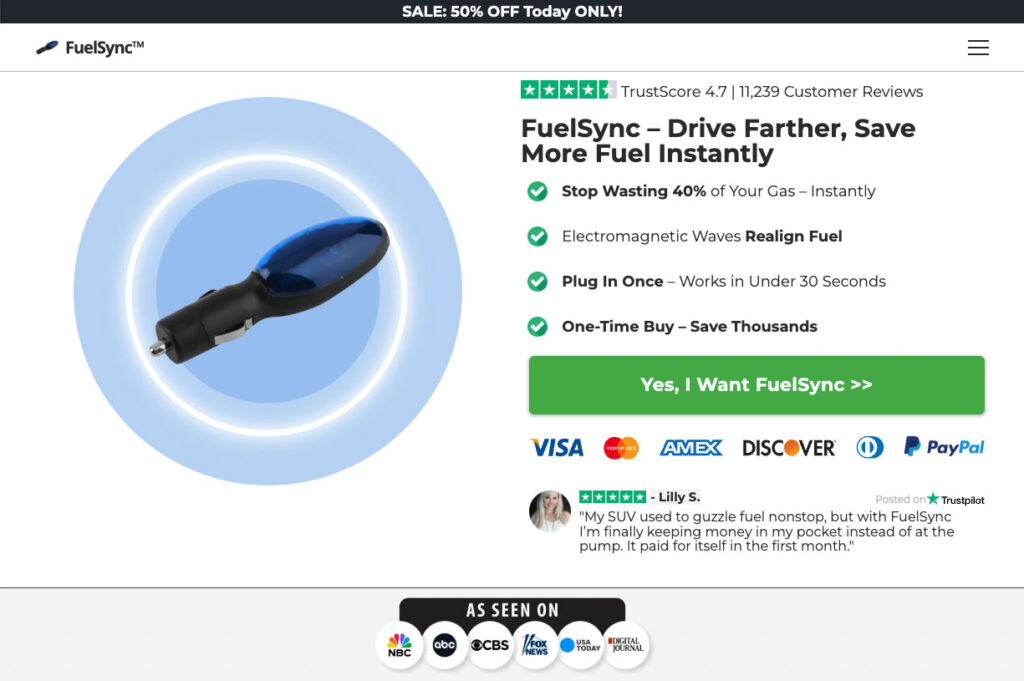
Verdict: CONFIRMED SCAM. I bought a FuelSync-style device, tested it for more than 60 kilometers, and recorded zero change in fuel consumption. I then traced the marketing behind it and found fake Trustpilot scores, fabricated media claims, recycled testimonials, and a device that has no data connection to the vehicle systems it supposedly controls.
Key takeaways
- I tested the device for more than 60 kilometers and recorded 0% change in fuel consumption, despite the advertised claim of 30% savings from day one.
- The device plugs into a 12-volt socket that supplies electrical power but has no data connection to the vehicle’s ECU, which controls fuel injection and combustion timing.
- FuelSync sales pages use a claimed 4.7/5 TrustScore and more than 11,000 reviews, but I found no corresponding review base on Trustpilot itself.
- The same device is marketed under names including NeoPocket and FuelEdge, while rotating domains, fake media logos and conspiracy-style claims are used to build credibility.
Is FuelSync Legit?
No. After testing the device myself and investigating how it is marketed, I found no credible basis for the promised fuel savings.
The claim I tested was specific: FuelSync supposedly delivers a 30% reduction in fuel consumption from the first day. My vehicle was consuming approximately 6.1 liters per 100 kilometers before the test. A 30% reduction should have brought that figure down to roughly 4.5 liters per 100 kilometers.
That would have been a substantial difference.
I bought the device, installed it in my car’s 12-volt socket and drove more than 60 kilometers with it connected. When I checked the fuel consumption afterward, the number was exactly where it had been before I installed the device.
Zero measurable improvement.
That result led me to investigate the hardware and the sales operation more closely. What I found explains why the road test produced the result it did.
The FuelSync Road Test
The first problem appeared before I even started driving.
According to the product’s own instructions, the device should light up when it is operating. Mine did not light up when I initially connected it to the 12-volt lighter socket. It remained inactive for a period before eventually lighting up.
I checked the manual for troubleshooting instructions. The suggested solution was to try the device in another vehicle.
That is not a meaningful way to establish whether a fuel-saving device is functioning. A buyer should not have to locate another vehicle simply to determine whether a supposedly plug-and-play product works.
Once the device eventually powered on, I continued with the road test.
I drove more than 60 kilometers with it installed throughout the trip. The fuel consumption reading at the end was unchanged.
The advertised 30% saving did not appear. Neither did a smaller measurable improvement.
Why the 12-Volt Socket Matters
This is the most important technical finding from the test.
The 12-volt lighter socket provides electrical power. It is not a data connection to the vehicle’s engine control unit, or ECU.
The ECU is responsible for managing systems involved in engine operation, including fuel injection and combustion timing. A device claiming to optimize those processes needs a functional way to communicate with the relevant vehicle systems.
FuelSync does not get that connection through the 12-volt outlet.
The device can receive electricity from the socket. It can illuminate an indicator. But simply receiving electrical power does not give it access to the ECU.
That creates a fundamental problem with the product’s central promise. The device is being marketed as though it can influence fuel consumption, yet the connection being used does not provide access to the systems responsible for controlling fuel delivery and combustion.
This is why I don’t regard my test as simply a case of receiving a defective unit. The physical setup itself contradicts the marketing claim.
FuelSync Is Sold Under Multiple Names
While investigating the product, I found that FuelSync is not presented as a unique invention with one consistent brand identity.
The same type of mass-produced gadget is sold through marketplaces including AliExpress, Alibaba, Temu, eBay and Walmart.com. The marketing operation places different names on versions of the device, including FuelSync, NeoPocket and FuelEdge.
The branding changes. The basic device does not.
That matters because consumers searching for reviews of one name can easily encounter another version of the same product later.
A different logo does not change how the device connects to the vehicle.
The Fake Trustpilot Score
One of the clearest marketing red flags is the supposed Trustpilot reputation.
FuelSync sales pages display a claimed 4.7 out of 5 TrustScore and more than 11,000 customer reviews, accompanied by green star graphics designed to resemble Trustpilot’s branding.
I checked Trustpilot itself.
The review base being advertised on the FuelSync sales pages was not there.
I also found testimonials being reused across different scam websites. One testimonial attributed to “Lilly S.” appeared with different profile photos on different sites.
That is not evidence of thousands of independent customers reviewing the product. It is recycled marketing material.
The Fake Media Logos
The sales pages also display “As Seen On” logos associated with major media organizations, including NBC, ABC, CBS, Fox News, USA Today and Digital Journal.
The investigation found no evidence that these outlets reviewed, tested or endorsed FuelSync.
The logos function as trust signals. They are positioned to make the product appear established and independently validated.
A recognizable news logo is not proof of an endorsement.
In this case, the marketing gives visitors the impression of media recognition without evidence that those organizations actually covered the product.
The “Realigning Fuel Molecules” Claim
The marketing goes beyond simply promising better mileage.
It claims the device can reduce fuel waste by 40% to 56%, use electromagnetic waves to “realign fuel molecules” and restore 100% fuel combustion.
Those claims need to be examined against what the device is actually connected to.
The device receives power through a 12-volt socket. That socket does not provide the data connection required to communicate with the ECU.
So the marketing describes a sophisticated intervention into engine operation while the physical product is simply plugged into a power outlet.
My road test produced exactly what that setup would lead me to expect: no measurable change in fuel consumption.
The Conspiracy Claims
The international versions of the campaign add another layer to the marketing.
I found a German-language version that claims oil companies are trying to suppress the product and that automakers deliberately keep vehicles inefficient to protect oil industry profits.
There is no evidence presented to support those claims.
This type of story serves a useful purpose for a deceptive sales campaign. If consumers ask why they have never heard of an alleged breakthrough, the marketing already has an answer: powerful companies are supposedly hiding it.
That turns skepticism into part of the story.
Instead of addressing the engineering questions, the campaign suggests that anyone questioning the product is simply unaware of the supposed cover-up.
Rotating Domains and Rebranding
The campaign also operates across multiple domains and country-specific versions.
The sales pages are translated for different markets while retaining substantially the same promotional structure. When one domain becomes difficult to use or attracts complaints, another can take its place.
That makes it harder for consumers to establish who is actually operating the campaign and harder to maintain accountability when something goes wrong.
The combination of different product names, multiple domains and localized versions also makes it harder for consumers to connect complaints about one version of the device to another.
FuelSync Claims vs. What I Found
| Marketing claim | What I found |
|---|---|
| 30% fuel savings from day one | 0% measurable change after more than 60 km of testing |
| Plug it in and it works instantly | The device initially failed to light up |
| The device realigns fuel molecules | The 12-volt socket has no data connection to the ECU |
| 4.7/5 TrustScore and 11,000+ reviews | No matching review base was found on Trustpilot |
| Seen on NBC, ABC, CBS and Fox News | No evidence was found that these outlets reviewed or endorsed FuelSync |
| 180-day money-back guarantee | The sellers operate through websites where support and refunds can be difficult to obtain |
Why Some Buyers May Think FuelSync Works
There is another issue worth addressing because it can make these products surprisingly convincing.
Fuel consumption naturally changes from one drive to another. Traffic, acceleration, driving style and road conditions all affect fuel use.
Someone who installs a new fuel-saving device may also unconsciously change how they drive. They may accelerate more gently, monitor the dashboard more closely or deliberately drive more economically because they expect the device to work.
That can create the impression that the gadget is responsible for an improvement.
A single trip does not establish causation.
My test was based on an actual fuel consumption measurement over more than 60 kilometers. The result did not show the promised improvement.
The 180-Day Money-Back Guarantee Is Another Red Flag
FuelSync advertises a 180-day money-back guarantee.
That sounds reassuring until you examine the seller behind the offer.
The marketing operation uses websites that can be replaced or rebranded, and the investigation found concerns about unresponsive customer support and refund requests that do not get processed.
A money-back promise only has practical value when there is a reliable company available to honor it.
If the seller disappears, changes domains or stops responding to customers, the guarantee printed on the sales page does not protect you from the transaction.
What Real Customer Evidence Does the Marketing Provide?
The strongest customer-facing evidence on the sales pages is the claimed Trustpilot score and the testimonials displayed alongside it.
But those claims do not hold up under closer inspection.
The advertised review count was not found on Trustpilot itself, while individual testimonials were found reused across multiple websites with different profile images.
That means consumers should not treat the sales page’s review section as independent evidence that FuelSync delivers the advertised savings.
The product’s own marketing cannot substitute for verifiable testing.
Is FuelSync a Scam?
Yes.
I reached that conclusion based on two separate lines of evidence.
First, I tested the device myself. After more than 60 kilometers of driving, fuel consumption showed no measurable improvement despite a specific claim of 30% savings from day one.
Second, I examined the mechanism being advertised. The device connects to a 12-volt power outlet, not the vehicle’s ECU. It therefore has no data pathway to the systems that control fuel injection and combustion timing.
Then there are the marketing red flags: the claimed Trustpilot score that does not match Trustpilot’s actual review base, recycled testimonials, unsupported media logos, rotating domains, multiple product names and conspiracy claims used to explain away skepticism.
Taken together, those findings support the scam verdict.
What Should You Do If You Bought FuelSync or NeoPocket?
If you already purchased FuelSync, NeoPocket, FuelEdge or a similarly branded device, check your credit card or bank statement and identify the exact merchant that processed the payment.
Contact your card issuer as soon as possible. Explain that the product was misrepresented and request a chargeback for the transaction.
Keep your order confirmation, receipt, emails, screenshots of the sales page and any correspondence with the seller. Those records can help establish what you were promised and what you actually received.
If the seller’s website is still accessible, save evidence of the claims before the page disappears or changes.
FuelSync FAQ
Is FuelSync a scam?
Yes. My road test showed no measurable fuel savings, while the device’s connection to the vehicle provides no data pathway to the ECU. The investigation also found fabricated trust signals and unsupported marketing claims.
Does FuelSync really save 30% on fuel?
My test did not support that claim. After driving more than 60 kilometers with the device installed, I recorded no change in fuel consumption.
Are the FuelSync Trustpilot reviews real?
The sales pages claim a 4.7/5 TrustScore with more than 11,000 reviews, but I did not find that corresponding review base on Trustpilot itself. Some individual testimonials were also reused across different websites.
Can a 12-volt socket control a car’s fuel injection?
The 12-volt socket used by this device supplies electrical power but does not provide a data connection to the ECU. That means plugging FuelSync into the socket does not give it access to the systems controlling fuel injection or combustion timing.
What other names are used for FuelSync?
The investigation identified versions marketed as FuelSync, NeoPocket and FuelEdge. The same type of device is also sold through major online marketplaces under different branding.
What should I do if I was charged for FuelSync?
Contact your bank or credit card issuer immediately, explain that you believe the product was misrepresented, and request a chargeback. Keep your transaction records and all communication with the seller.