Neurodyne Drops Review: Did Dr. Peter Attia Really Endorse a Honey and Bilberry Recipe for Alzheimer’s?
If you’ve seen a “60 Minutes” clip online claiming Dr. Peter Attia discovered a natural honey and bilberry recipe to reverse Alzheimer’s disease and dementia — and that it’s been bottled into a product called Neurodyne — stop right there. Dr. Peter Attia never endorsed Neurodyne drops. He never promoted a honey and bilberry recipe as an Alzheimer’s cure. He never appeared on any program to validate miracle cognitive supplements of any kind. What you watched was a deepfake.
Here’s everything you need to know about this scam.
What Is Neurodyne?
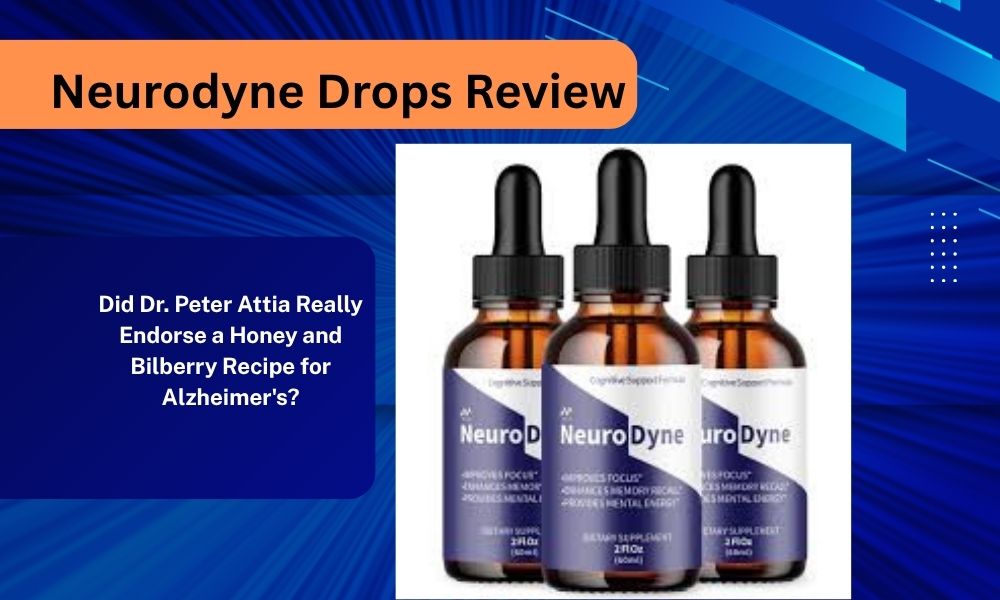
Neurodyne is a dropper bottle supplement marketed online with extravagant claims about reversing memory loss, eliminating brain fog, and curing Alzheimer’s disease and dementia. The product has no backing from any doctors, hospitals, universities, or credible public figures. There are no legitimate reviews for Neurodyne, no identifiable founder, no verifiable company address, and no information about where or how it is manufactured.
When a product has none of those basic identifying details, that is a serious warning sign. Do not spend your money on it.
The Fake “60 Minutes” Website
The Neurodyne scam begins with a social media advertisement — typically appearing on Facebook, Instagram, or TikTok — that leads users to a website designed to look exactly like the CBS “60 Minutes” website, complete with the network’s graphics and branding. It is not affiliated with CBS or “60 Minutes” in any way. It is a fraudulent imitation built to deceive.
The fake report displayed on this site makes a series of completely fabricated claims, including:
- “The forbidden protocol: why Big Pharma paid millions to bury Dr. Attia’s memory discovery”
- “After DOJ document dump, Stanford researchers break silence on the 100% natural method that reverses dementia in 15 days”
- “FDA grants record-speed approval”
None of these things happened. There was no DOJ document dump. Stanford researchers made no such announcement. The FDA issued no such approval. These are invented headlines designed to look credible enough to keep you watching.
The Dr. Peter Attia Deepfake: What’s Really Happening
Dr. Peter Attia has, in fact, appeared on the real “60 Minutes” program — but as a guest discussing legitimate topics in health and longevity. He has never spoken about Neurodyne, honey and bilberry recipes, or any supposed Alzheimer’s reversal protocol.
What scammers have done is take footage of Attia from his actual television appearances and apply deepfake artificial intelligence technology to manipulate his lip movements and replace his voice with AI-generated audio. The result is a video that appears to show Attia endorsing miracle claims he never made and would never make.
The same technique is applied to CBS anchor Norah O’Donnell, whose lip movements are also visibly manipulated in the fake segment. Neither Attia nor O’Donnell has any connection to Neurodyne whatsoever.
To be absolutely clear: no doctors, hospitals, universities, or public figures — including Dr. Peter Attia, Dr. Mehmet Oz, Dr. Phil McGraw, or anyone else — have ever endorsed Neurodyne, reviewed its ingredients, or validated any recipe involving honey and bilberry as a treatment for Alzheimer’s or dementia.
The Honey and Bilberry Recipe Lie
Throughout the long scam video, viewers are shown tantalizing glimpses of what appears to be blueberries, honey, and other pantry-staple ingredients. The implication is clear: somewhere in this video, you’ll be given a powerful natural recipe that can dissolve the toxic brain “crust” causing Alzheimer’s and dementia.
That recipe does not exist.
Showing you familiar kitchen ingredients is a deliberate hook to keep you watching. The scammers never reveal the full recipe because there is no recipe. There is no combination of honey, bilberries, blueberries, or any other pantry ingredient that can reverse Alzheimer’s disease, cure dementia, eliminate brain fog, or repair neurological damage. Anyone claiming otherwise is not a scientist — they are a scammer.
The tactic is simple: dangle the promise of a free remedy long enough that by the time the video ends and a product appears on screen, you’ve invested enough time and hope that you’re willing to buy it.
What the Scam Video Claims
Beyond the fake kitchen recipe, the Neurodyne promotional video makes a series of pseudoscientific and conspiratorial claims designed to tap into distrust of pharmaceutical companies and government institutions. These include:
On the cause of Alzheimer’s: The video falsely claims the real cause of Alzheimer’s is a “planned combination” of microplastics, graphene oxide from vaccines, and elevated glyphosate levels in genetically modified foods — together forming a toxic “crust” that suffocates brain neurons. There is no credible scientific evidence for any of this.
On Big Pharma suppression: The video claims Eli Lilly’s drugs Aricept and Namenda were deliberately designed to fail so patients stay sick and keep spending money. It claims the video itself is being “taken down every 40 minutes” by Eli Lilly, Pfizer, and the U.S. government. This is manufactured urgency designed to exploit reasonable frustration with pharmaceutical pricing — not evidence of any real suppression.
On electromagnetic pollution: The video goes on to blame 5G networks, Wi-Fi, and Bluetooth signals for accelerating neurological degeneration, citing a supposed Harvard University article published in August 2024. That article does not exist. Harvard University has nothing to do with Neurodyne or any endorsed dementia reversal solution.
On Stanford research: The video claims a Stanford University study authored by Dr. Attia has overturned 60 years of brain medicine consensus and documented a protocol that will “effectively end the memory loss epidemic in America by November 2029.” No such study exists. Stanford has no connection to Neurodyne.
Brazilian Scam Operations and Product Name Cycling
This style of scam funnel — fake network website, deepfake celebrity endorsement, pseudoscientific kitchen recipe promise, dropper bottle at the end — shows signs of originating from scam operations based in Brazil. These groups run dozens of near-identical campaigns simultaneously, cycling through product names regularly to stay ahead of search engine scrutiny and consumer complaints. Neurodyne is one name in a long rotating list.
This is why you may find it impossible to locate any parent company, registered business, or verifiable founder behind Neurodyne. That invisibility is not accidental — it is by design.
What Happens After You Buy
If you purchase Neurodyne through the scam funnel, several things are likely to follow:
- Despite claims of “no auto-ship,” you may find yourself enrolled in a recurring monthly subscription and billed hundreds of dollars.
- The money-back guarantee advertised is likely not to be honored.
- Customer service will be difficult or impossible to reach.
- The product itself will do nothing for Alzheimer’s, dementia, memory loss, or brain fog.
What To Do If You Already Ordered Neurodyne
If you placed an order after watching one of these videos, act immediately:
- Contact your bank or credit card company and report the charge as fraud. Request a chargeback.
- Cancel any recurring billing attached to your account — look for subscription charges you may not have noticed at checkout.
- Do not rely on the product’s money-back guarantee. Pursue your refund through your financial institution, not through the seller.
Why These Scams Keep Thriving
The platforms that carry these advertisements — Meta (Facebook and Instagram), TikTok, and others — profit from the ad revenue generated by scam campaigns. Despite clear violations of consumer protection principles, billion-dollar tech companies have little financial incentive to police scam ads at the scale needed to stop them. The burden of identifying and reporting scam ads is routinely placed on users rather than the platforms that profit from them.
Until that changes, the best defense is awareness. Share this article. Tell people in your life who might be searching for Alzheimer’s and dementia answers online that these scams exist and what they look like.
The Bottom Line on Neurodyne and Dr. Peter Attia
| Claim | Reality |
|---|---|
| Dr. Peter Attia endorsed Neurodyne on “60 Minutes” | False — deepfake AI manipulation |
| Stanford researchers validated the protocol | False — no such study exists |
| FDA granted record-speed approval | False — completely fabricated |
| Harvard published confirming research in 2024 | False — that article does not exist |
| Honey and bilberry recipe reverses Alzheimer’s | No scientific basis whatsoever |
| DOJ document dump exposed Big Pharma | False — invented narrative |
| “60 Minutes” website hosting the video is real | False — fraudulent imitation site |
Dr. Peter Attia never endorsed an Alzheimer’s cure. There is no honey and bilberry recipe that reverses dementia. Do not buy Neurodyne or any product marketed through these methods.
If you or someone you love is experiencing symptoms of Alzheimer’s disease, dementia, or cognitive decline, please make an appointment with a licensed medical professional. Real help exists — but it won’t be found in an Instagram advertisement or at the end of a 45-minute deepfake video.